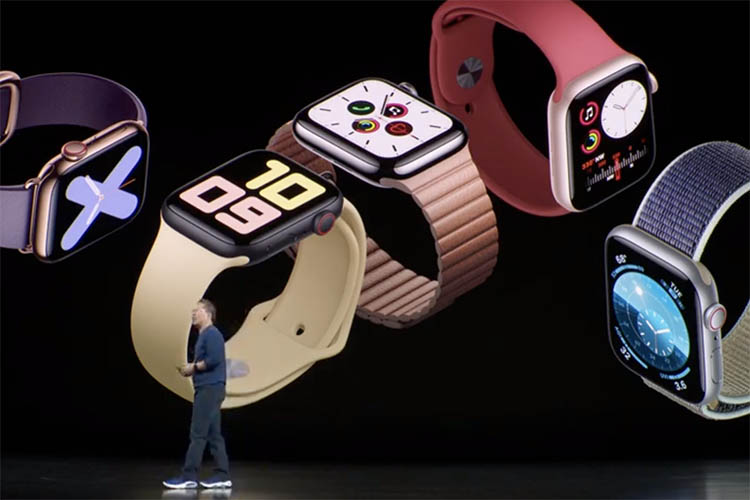
At its September event today, Apple has launched the new Apple Watch Series 5. The Series 5 brings a bunch of improvements over the Apple Watch Series 4 from last year.
One of the biggest changes in the Series 5 is the addition of a new Always on Display which is finally now available on the Apple Watch. For this, the company is using a new low power display driver, a new ambient light sensor, and what the company claims is the only LTPO display out there in a watch which can set dynamic refresh rates for the display from up to 60Hz all the way down to 1Hz, for extra battery saving.
The Apple Watch Series 5 will also come with compass, which users can add to their home screen as well. The company has also improved emergency calling in its LTE models, which will now allow users to call emergency services in over 100 countries even without an iPhone.
The Apple Watch Series 5 is available in multiple cases, Aluminum, Stainless Steel, Titanium, and Ceramic. The aluminum Series 5 Apple Watch will be available in silver, space gray, and gold. The stainless steel watch will be available in gold, space black, and polish colours.
The Apple Watch Series 5 starts at $399 for the GPS model, and $499 for the LTE model. The watch can be pre-ordered starting today itself, and will go on sale starting September 20.
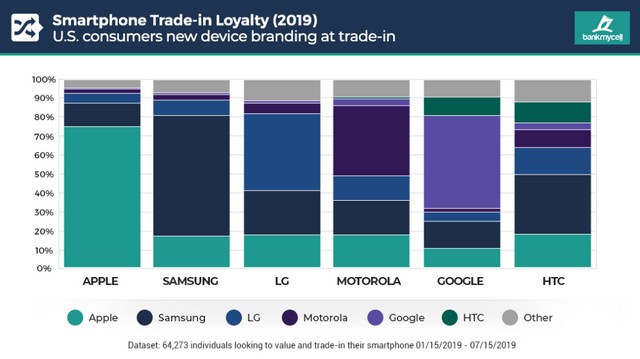
In its latest smartphone brand loyalty study, electronics buy-back site, BankMyCell, has claimed that Apple and Samsung stand out as the two manufacturers with the highest brand retention among US residents. According to the report, Apple had 74.6 percent iPhone trade-in brand loyalty, while Samsung’s trade-in loyalty was only a tad lower, at 63.9 percent. While 12.8 percent of iPhone users switched over to Samsung, as much as 17 percent of Samsung users picked up an iPhone, the report said.
The data further indicated that while Google only had a 51 percent trade-in loyalty, just 10.1 percent of Pixel users were trading in their devices for iPhones, meaning most of them stayed on with Android, as expected. The study, based on 64,273 unique users between Jan 15 and July 15 this year, also looked at LG, Motorola and HTC, all of whose brand loyalty fell below 41 percent at trade-in. “Only 10.8 percent of HTC respondents stayed loyal, with 32.1 percent heading to Samsung, 17.1 percent to Apple”, said the report.
Chart Courtesy: BankMyCell
Another interesting thing to have come out of the study is that Android users seem to be more loyal to their platform than iOS users. While 25.6 percent iPhone owners moved to Android devices, an overwhelming majority of Android users chose to remain with the platform. According to the report, between 82-90 percent of all Android users surveyed upgraded to another Android device, whether from the same brand or otherwise.
US is the only major market where iPhones outsell Android devices, which is why it is interesting to see so many more Android users seemingly sticking with the platform instead of jumping ship to what is arguably the more popular platform in the country.
iPhone vs. Android. It’s been an ongoing debate since the HTC Dream became the first commercially-available Android device in September 2008.
These days, I’m firmly on the Android side of the fence. I’ve owned iPhones, my wife is still an iPhone user, and I’m more than capable of appreciating just how revolutionary the iPhone was when it first released. Android is just better.
But beware! If you’re a fellow member of the Android master race, you’ve got an important responsibility not to upset our iOS-using brethren. With that in mind, here’s a handy guide of phrases you should never say to an iPhone user.
1. “What Do You Use Your Old Headphones For?”
iPhone’s lack of headphone jack inconveniences me on like a daily basis
In 2016, Apple famously ditched the headphone jack on the iPhone 7. Three years later, it’s still absent and showing no signs of a return.
Android users, of course, have felt the ripple effects. Many Android devices also now ship without the 3.5mm jack. But crucially, we have a choice. Notably, the latest flagship Samsung Galaxy S10 still a has a headphone jack.
So what did your friend do with her super-expensive wired headphones? It’s best not to ask. They might not have seen the Android light, but you still want to be friends with them (right?!).
To be extra safe, don’t mention anything about audio quality or lost earbuds either!
2. “Why Did You Buy a Case?”
Look, we get it, iPhones are seriously expensive. People want to protect their investment.
But there’s a juxtaposition at play. One of the biggest selling points of the iPhone—and one of the arguments that iOS advocates cite most frequently—is the design.
iPhones are gorgeous, not to mention that Apple has been on a never-ending quest to make its devices thinner, shaving off fractions of millimeters with each new release.
So why, therefore, do people insist on sticking their phone in a bulky case? Is that not undoing Apple’s hard work?
Ah right, it’s to stop the bending…
3. “Why Are You Late? I Sent You Directions!”
The party is in full swing. The introductory pleasantries are over, and the drink is flowing. But wait; where’s your friend? She was supposed to be here two hours ago.
Finally, she arrives. She’s wearing a furious expression. And the reason for her annoyance? Apple Maps. It’s the default map app on iOS, and you cannot change it.
And that’s bad news. As recently as November 2018, Apple Maps had more detail than Google Maps in just 3.1 percent of the US. Justin O’Beirne explained all this in infinitely more detail than we ever could in a blog post.
Instead of castigating your friend for relying on such a poor app, perhaps you should gently remind them that a traditional paper map is more reliable and just a fraction of the cost of a $1,000+ Apple phone.
4. “You Should Have Bought the 512GB Model”
The entry-level iPhone XS sells for $999, but it only has 64GB of storage. That’s a con—it’s nowhere near enough space for all your apps and media in 2019.
Consequently, most people opt for the 256GB model. It will set you back $1,149. If you want the maximum capacity 512GB version, you will need to shell out an eye-watering $1,349, and that’s before any other extras.
The price of the extra storage means iPhone users can be a bit touchy when they run out of space. They either need to wipe some of their data, or subscribe to an expensive iCloud plan.
To prevent them from getting even angrier, we don’t think it’s wise to mention that several Android phones have expandable memory thanks to an SD card slot. Definitely don’t mention that you can pick up a 200GB card on Amazon for $20-$30, depending on the brand.
5. “Can I Borrow Your Charger?”
I have one charger. It powers my phone, my Bluetooth speaker, my headphones, my MP3 player, my tablet, and my GoPro. And as the world transitions to USB-C, I’ll even be able to charge my laptop.
iPhone owners aren’t so lucky.
Remember my wife that I mentioned earlier? She has three different chargers for her 2015 MacBook Air, 2012 MacBook Pro, and iPhone 7. Her old iPod—which admittedly she rarely uses anymore—also has a different connection. It’s almost at the point where she needs to book an extra luggage allowance whenever we fly anywhere.
Again, any discussion of the cost of official/certified Apple chargers is also out of bounds. And don’t even think about raising the issue of dongles.
6. “Just Sideload It…”
There are lots of reasons why an app you want might not be available in the Google Play Store. It could be geo-blocked, perhaps it deals with adult content, or maybe it’s only available through one of the many third-party Android app stores.
When it happens, it’s frustrating. You have to use a reliable APK site to download the installation file, then sideload it onto your device.
But it’s a whole lot more frustrating for iOS users. It is technically possible to sideload apps, but it either requires some trickery with Apple developer certificates or, more commonly, jailbreaking the OS. Neither process is recommended.
7. “Siri, Why Is Google Assistant Better Than You?!”
Our final piece of advice isn’t so much something you shouldn’t say to an iPhone user; rather, it’s something you shouldn’t say in front of them.
To be fair, Siri has closed the gap on Google Assistant in the last couple of years, but the general consensus is that Google’s tool is still the better product.
Honestly, the question of which assistant is the best is somewhat moot. The differences are close enough that iOS users can make a genuine case for Siri.
So if you want to avoid a raging argument over the dinner table, quietly ask Siri to play some music and keep your opinions to yourself.
What Else Do You Keep Quiet About?
If you’re an Android user who has been nodding along to this article, we want to hear from you.
What else would you add to this list? Which sensitive topics do you avoid when you’re with your iOS-using buddies? Let us know in the comments.
Since last March, WhatsApp started implementing a so-called ‘Temporary Ban’ on some users for allegedly using unofficial versions of the app. The company has now updated its FAQ page to state that users who have been temporarily banned may lose their entire chat history if they don’t migrate to the official app soon.
According to WhatsApp, it is being forced to take this step out of security concerns, as unsupported apps and altered versions of WhatsApp, such as WhatsApp Plus, GB WhatsApp, or apps that claim to move WhatsApp chats between phones, could pose a major privacy concern for users. “These unofficial apps are developed by third parties and violate our Terms of Service. WhatsApp doesn’t support these third-party apps because we can’t validate their security practice”, said the company.
In case you’re one of the users facing a temporary ban, WhatsApp advises you to backup your chat history before moving to the official app. The process to migrate chat history reportedly varies from one third-party app to another, so affected users may check out the exact details on the official WhatsApp FAQ page.
WhatsApp has been trying for a long time to get rid of all the third-party versions of its popular messaging app, even though they use the same, standard Android APIs certified by Google. The company last year started sending legal notices to developers of many such apps, and revoked their limited license to access WhatsApp Services. The company had also directed them to immediately stop the development and operation of any such apps that interfaced with the platform.